
Tim-Bor Professional Insecticide

Tim-bor Professional Insecticide and Fungicide is a water-soluble borate powder that defends your wood structures against wood-ingesting insects and fungal decay. Apply Tim-bor as a dust, or mix with water and spray onto bare wood to achieve affordable, long-term protection and pest control. Tim-bor Professional is effective on most interior and exterior woods.
From $18.99

Size
Typically ships in 1-2 business days
Details

Give your logs the lasting protection they deserve with Tim-bor Professional Insecticide, a borate-based powder that helps fight against serious threats like rot, weather, fungi, and wood-destroying insects such as termites, house borers, powderpost beetles, and carpenter ants. Tim-Bor is a highly effective product—which can be applied as a dust, liquid, or foam—creates a shell of protection that won’t break down over time, helping you avoid costly structural damage and repair.

Tim-Bor Features and Benefits:
• Prevents and protects against wood ingesting insects and fungi-related decay
• Kills termites in as little as 7 days
• Flexible application (as dust, liquid, or foam solution)
• Less toxic than other wood preservation chemicals
• Can be used in conjunction with fumigation

Product Uses, Applications, & Tips:
• For use on above-ground wood surfaces, including logs, timbers, dimensional lumber, siding, etc. Effective against rot, fungal decay, and most woodboring insects.
• Apply product via brushing, spraying, dipping, kerf-flooding, or hole flooding.
• Use on bare wood; do NOT use on wood with a stain or coating on it. Tim-bor cannot penetrate coatings to provide the necessary protection.
• Tim-bor will not interfere with the adhesion of most wood stains and coatings, but it must be applied first/underneath. The surface should be completely dry before applying any coating. Wood subject to direct moisture contact must be coated with a good water-repellent finish after treating with Tim-bor.

Disclaimer (Carpenter Bees & Blue Stain):
Timbor does not control carpenter bees or the organisms that cause blue stain (the gray to black marking often present in dry wood). If blue stain is a problem, an additional fungicide may be needed.

Tim-Bor Hazards/Cautions:
This product is harmful if inhaled or swallowed, and may cause moderate eye irritation. Avoid breathing in dust, and avoid contact with eyes or clothing. Wash hands thoroughly with soap and water after use.

Tim-Bor Professional Insecticide Resources:
Tim-Bor Professional Insecticide Brochure
Tim-Bor Product Label
Tim-Bor Professional Insecticide Tech Data Info

Specifications
More Information

Surface Preparation
• Product must be applied to bare wood (free of dirt, wax, mill glaze, and surface finishes).
• Remove all previous stains, coatings, foreign matter, and impermeable materials that could decrease treatment effectiveness on the areas being treated.
• It is best to apply Tim-bor to dry wood. Do not apply to wood with a surface temperature below 40̊F or above 90̊F.

Solutions Preparation:
10% Tim-bor Professional Liquid Solution: To prepare solution, add approximately 80% of the required volume of water to the mixing vessel. While stirring, gradually add 1 pound of Tim-bor Professional for each gallon of treating solution required. Add remaining water to the solution and stir until the entire product has dissolved.

15% Tim-bor Professional Liquid Solution: Prepare solution as above, but gradually add 1.5 lbs of Tim-bor Professional for each gallon of treatment solution needed. Use this solution as soon as possible and do not store for an extended length of time.

15% Tim-bor Professional Foam: Prepare a 15% liquid solution as described above and also add a surfactant-foaming agent. Generally 1-2 ounces of a foaming agent, added to the 15% liquid solution, produces a dry foam with the desired expansion ratio of approximately 20 to 1 (20 gallons of foam per 1 gallon of liquid solution). The Tim-bor Professional foam should be of a "dry" consistency that adheres to wood surfaces so that run-off is minimized. A "wet" foam may damage wallboard or other building components. Refer to the individual foam equipment manufacturer's manual and the surfactant's label for specific instructions. Wash and rinse all equipment after each use.


Applying Tim-bor:
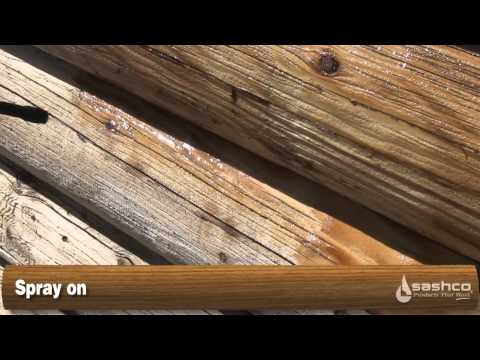
• Apply Tim-bor at the rate of 1 mixed gallon per 150 sq. ft of wood surface. Apply a second coat 4 to 24 hours later. Thoroughly soak cut ends, checks and cracks.
• Coat the logs with a water-repellent finish after the Tim-bor solution has thoroughly dried. Use a moisture meter to verify that the log’s moisture content doesn’t exceed 19%.

Liquid Application: Drill and then inject the liquid solution under pressure into sound wood or until run-off is observed coming from entry/exit holes of infested wood. Liquid applications may be made to wood structures including decks, fences, steps, sheds, barns, and other outbuildings. For remedial control of wood attacking organisms or for the protection of wood against future infestations, two applications of a 10% liquid solution are required. One application of a 15% liquid solution may be used. Apply TIM-BOR Professional solutions by brush or spray at the rate of 5 gallons of liquid solution per 1,000 sq. ft. of wood surface area. Thoroughly wet wood surface area.

Powder Application: Apply Tim-bor Professional as is to wood members by drilling and injecting the powder into galleries or by dusting generously on wood surfaces. The powder can also be injected or dusted into wall voids such as between studs, block voids, box sills, eaves, attics, soffits, etc. Apply powder to these areas at the rate of 0.5 ounce (12-14 grams) per square foot.

Foam Application: In wall voids, inject enough dry foam to contact wood surfaces of studs in the wall or the entire desired target area. Apply foam, where possible, to abutting wood surfaces and between wood joints. Apply the foam so that all accessible wood surfaces are covered with foam. Tim-bor Professional foam can also be injected into insect galleries until run-off is observed.

Please Note: Treated wood must be protected from direct contact with moisture or the active ingredient may leach out. It’s best to wait at least 48 hours (in warm, dry weather; longer in cool, humid weather) after applying Tim-bor to coat wood with a water-repellent finish. Let the surface thoroughly dry and brush away any crystals that appear before staining. Use a moisture meter to verify that the logs’ moisture content doesn’t exceed 19%.


Specifications for Recommended Applications:
1. Structural Wood and Sill Plates: Treat all structural concrete, block, steel & wood and sill plates up 24 inches from contact with foundation as required by label.
2. Sheathing: Treat all cellulosic sheathing within 24 inches of the foundation.
3. Concrete Slab: Treat concrete slab a minimum of 2-8 inches out from all sill plates.
4. Bath Traps: Treat open bath traps and surrounding 12 inches of slab area.
5. Penetrations: Treat all pipe and plumbing penetrations to a height of 24 inches and a minimum of 6 inches surrounding penetration.
6. Crawlspace: Treat interior surface of crawlspace concrete or concrete block walls extending up vertically 24 inches from soil.
7. Crawlspace/Basement Flooring: Treat all sill plates, box headers and joists 24 inches out from contact with foundation walls or piers.
8. Basement: Treat interior surface of basement concrete or concrete block walls extending up vertically 24 inches from slab.
9. Expansion Joint and Abutting Connections: Treat abutting slab areas and expansion joints a minimum of 6 inches out on each side of joint or abutting slab connection.

Storage and Disposal:
• Pesticide Storage: Store in a dry place. Do not store where children or animals may gain access.
• Pesticide Disposal: Wastes resulting from the use of the product may be disposed of on site or at an approved waste disposal facility.
• Container Handling: Non-refillable container; do not reuse or refill this container. Completely empty container by shaking and tapping sides and bottom to loosen clinging particles. Empty residue into application equipment; then offer for recycling, if available; or dispose of in a sanitary landfill; or, if allowed by state and local authorities, by incineration. Do not contaminate water, food, or feed by storage or disposal.

Clean Up:
• Use soap and water to clean equipment, skin, and clothing.

Further Resources:
Tim-Bor Professional Insecticide US Safety Data Sheet (SDS)
Tim-Bor Professional Canada MSDS
Tim-Bor 3 Part Architectural Specification Guide

Reviews
Product Questions

Product Questions

  • Can Tim-Bor be shipped to Canada?

    Yes, Tim-bor Professional is registered with Health Canada’s Pest Management Regulatory Agency (PMRA) under the Pest Control Products Act (PCP) (PCP Reg. No. 24091).

  • Is Tim-Bor any different from Penetreat?

    Tim-Bor and Penetreat are both powdered borate insecticides. 

  • Is it okay to mix Tim-Bor in with my stain?

    No, Tim-Bor works by soaking directly into bare wood. It needs to be a layer underneath your stain.

  • Does Tim-Bor work if there is already stain on the wood?

    We recommend using Tim-Bor only on bare wood.  Tim-Bor works by soaking deep into the wood fibers.  Most stains and paints are coatings, which form a thin and flexible solid barrier around the surface of the wood.  When working properly, a coating stain will prevent the borate-water solution from passing into the wood.

  • Does Tim-Bor protect against carpenter bees?

    Unfortunately, borate insecticides are not effective against carpenter bees as they work when ingested by the insect.  While boring holes, carpenter bees chew and discard the wood without ingesting it.